Arthritis

Living with Arthritis
I was just responding to a member to regarding arthritis and as I was posting, I realized I started to write a book.
I have had my spinal surgeries (1978 – 2000), and I have suffered through all the pre-surgical post-surgical roller-coaster rides, the ups/downs, the flare ups, and of course the uninvited visits from the Beast.
Since around 2004, I started to become familiar with Arthritis. I can and have pointed to formal Spine-health articles/videos that best describe the ailments and treatments, but for this one, I am going to keep it personal. I will add that in my opinion, the best site to learn all about arthritis is http://www.arthritis-health.com/.
This site is a sister site (lack of a better term) to Spine-health. Veritas Health is the parent company of Arthritis-health.com and Spine-health.com.

What is arthritis and what types are there?

 RA – Rheumatoid Arthritis   is a chronic inflammatory disease and is classified as an autoimmune disorder. RA, which can be painful at times, can be controlled, managed, and improved with medications and exercise.
OA –Osteoarthritis  is a type of degenerative arthritis that occurs when the cartilage that acts as padding between the joints breaks down. This type of arthritis unfortunately does not have a medical solution. There are exercises and medications to help with the pain, but like many other treatments for the spine, these provide temporary relief only. As the joints wear down more, the only option becomes surgery.

When I heard the word arthritis, the image that I saw was of an elderly person with bent fingers and a slow gait. Those images are valid, but take away the age portion. As I stated earlier, I was diagnosed in 2004, but I really did not fully understand the implications. The pain started in my shoulders. The right one hurt first. I had trouble lifting my arm, grasping things and even trying to shake someone’s hand.

My neurosurgeon sent me to a shoulder specialist who started with series of steroid injections. They helped so much. In fact after the second injection, I was almost pain free for 14 months! But when both shoulders started to cause problems, more steroid injections were given. However, there is a medical limit to how much injected steroids can be given to a person without negative impacts.

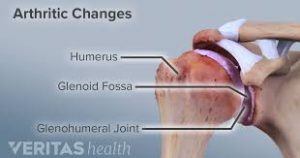
The doctor told me that the solution was complete shoulder replacement. I had no idea what that was. The doctor showed me my MRI and x-rays of both shoulders at different intervals. It became clear that as time when on, all that was left was bone to bone contact, tears and many bone spurs. Total shoulder replacement surgery is one of the most complex joint replacements procedures available, and it has the most painful and lengthy recovery period.

I had my right shoulder done in April in 2010, then the left one in October 2010. The recovery from shoulder surgery is long and painful. Besides the normal PT, I did pulley activities 3x per day which would bring me to tears each time. All in all, the total recovery time was about 15 to 18 months requiring hard work and intense therapy. But that hard work did pay off for me. I do not have any shoulder pain, and I can lift my shoulders better now with more range of motion than before.

In the beginning of 2011, I started having problems with my hip. Initially, it was diagnosed as a groin problem. I spent about 4 weeks with treatment aimed at my groin. Based on a x-ray and clinical review, it was determined it was my hip. Now looking at those images, I could figure out what the next step would be. I had problems walking, and if I got down on the ground, I could not get up without help. I finally had total hip replacement surgery in October of 2011. The recovery for the hip was like a walk in the clouds compared to the recovery from my shoulder surgery. The key to success lied in the surgeon’s ability. The surgeon must make sure both legs were equal in length.

Now, as a side note,, I developed medically induced cataracts (as opposed to cataracts caused by aging) from the steroid injections. I had cataract surgery in my right eye in September of 2012. This was the best surgery I could have had. I experienced a simple and easy recovery starting the moment the surgeon finished. My vision went from 20/110 to 20/20 in 24 hours.

Now, my right hip was getting jealous because it wasn’t getting the attention my other joints had. I had my right hip totally replaced November 2013. Again, the recovery has been great, and when it comes to my hip and leg, I am golden.
<strong>However</strong><code></code> nothing is easy. My back took a major toll from these arthritis surgeries. A new MRI showed a bit more herniation at L4/L5, plus increased stenosis at L2/L3. But those are conditions I have dealt with almost all my life (except that the stenosis is now in a new place. I already had L4/L5/S1.)

Right now, looking over the past 35+ years I cannot identify which condition caused me the most pain and discomfort. I can’t pinpoint the best, recovery or the best final outcome. I guess in many ways, they have all contributed to the final outcome. Well, this story isn’t over. I know there is more in store for me (my knees). I choose to keep on fighting and keep on trucking.

The arthritis condition is always there. It can impact almost everything I do, even the simplest things. I have so many Arthritis-Buddy-Aids that I could open a store. I understand that the major joints are replaced with a 20 year warranty, so who knows what will happen when 20 years have passed.For now, it’s the simpler things that are difficult like opening jars, and trying to put a seat belt on. The list can go on and on.

How did this all get started?

Who knows……  Can I stop it?……..             No 

I do know that the numerous spinal surgeries, which are a type of trauma have had an impact. The surgery-induced trauma accelerates those other conditions: stenosis, degenerative disc disease, and arthritis. They appear earlier and with more severe symptoms. It doesn’t seem to paint a great picture for the future. It would be easy to[u] throw the towel[/u] in and let things just happen.

But that is where I take a stand. I always talk about being positive and never saying never. Nothing has stopped me so far. My conditions and surgeries may have slowed me down a bit, but I will continue to move ahead.
I look forward to seeing that  Beast and fighting with it, so I have the upper hand.
Learn more about Arthritis, read up on it. You want to know more about it before it starts to know you!

Enjoy your MRI

How to enjoy your MRI

No matter how many times I’ve had a MRI , I still never enjoy going through it.
The MRI’s are much better than they were 10 or even 5 years ago, but still.
I had one last Friday and was totally prepared going in for it….

1 Take some of your pain meds or muscle relaxers PRIOR to going in. (You want to be relaxed, you could also have 2 or 3 Martinis before hand, but then you will have the urge to go to the bathroom inside the tube)

2 Arrive at the center upbeat and knowing that the MRI is going to be easy this time. (Mind over matter, this is a piece of cake, I will show them)

3 Think happy thoughts as you disrobe and put on those hospital gear (About now, the only thing you are happy about is that the newer hospital apparel actually covers your butt!)

4 Scratch all possible parts of your body that will somehow itch inside the tube (This is always a problem, you prepare yourself, you convince yourself that you will not itch. Problem is shortly after inside of the tube, you know you were lying to yourself)

5 Laugh with the technician, telling them, ah, MRI’s are a piece of cake (this helps build up your confidence)

6 Start to think of the ocean, vacation, your team winning, as you start to slide into the tube. (So far things are going good)

7 Oh oh, wait this tube got much smaller than last time, my arms are getting crushed, I cant move (Start to think, I should have went on that diet last month, its not to late to chicken out and press the buzzer to let you out)

8 Slowly you start to sweat and its coming down close to your eyes. You know the moment it hits your eyes, its going to burn and sting, and you know you cant do a thing about it (You start to try to turn your lips up and blow real hard to stop the sweat drops from coming down your face)

9 The drums and the banging start – At first you are scared, but welcome the distraction. (But after a while, the whole tube starts to vibrate, you think something has gone wrong, maybe I did leave a piece of metal on, and its going to come smashing up into my face)

10 The technician says over the loudspeaker, “Is everything ok”, you respond, sure, no problem (But in reality, you want to tell them, stop it, turn the machine off, I really dont need this MRI)

11 The tube starts to move out, you say to yourself “Its over!”, you are beaming with joy.. (Then the technician tells you, I am going to inject the contrast and then you only have 5-10 minutes more …. No What, I am NOT going back into that tube, forget the contrast, my doctor can read the MRI without that)

12 Real panic starts to set in. (You are clammy, You are sweating through those hospital pants which is NOT too comfortable. You try to dream, doesnt work, you try to think of your first date, doesnt work, for a second you open your eyes and ARGGGH, you are staring up at the top of the tube which is about 1 inch from your face!. Your stomach starts to turn, you try to take a deep breath, but nothing works)

13 The tube starts to move out again ( Its over , its over, its over )

You get up acting real strong, saying to the technician “Hey that was easy, piece of cake” You go back to the changing room, get dressed again and get ready to pick up the MRI CD and go home..

The technician greets you. “Sorry, we had a little problem, the film did not work correctly, we need to go through it again”

There you are , on the floor, crying whimpering like a little child….. No, NO NO

Spoon Theory

 The Spoon Theory
by Christine Miserandino


My best friend and I were in the diner, talking. As usual, it was very late and we were eating French fries with gravy. Like normal girls our age, we spent a lot of time in the diner while in college, and most of the time we spent talking about boys, music or trivial things, that seemed very important at the time. We never got serious about anything in particular and spent most of our time laughing.

As I went to take some of my medicine with a snack as I usually did, she watched me with an awkward kind of stare, instead of continuing the conversation. She then asked me out of the blue what it felt like to have Lupus and be sick. I was shocked not only because she asked the random question, but also because I assumed she knew all there was to know about Lupus. She came to doctors with me, she saw me walk with a cane, and throw up in the bathroom. She had seen me cry in pain, what else was there to know?
I started to ramble on about pills, and aches and pains, but she kept pursuing, and didn’t seem satisfied with my answers. I was a little surprised as being my roommate in college and friend for years; I thought she already knew the medical definition of Lupus. Then she looked at me with a face every sick person knows well, the face of pure curiosity about something no one healthy can truly understand. She asked what it felt like, not physically, but what it felt like to be me, to be sick.
As I tried to gain my composure, I glanced around the table for help or guidance, or at least stall for time to think. I was trying to find the right words. How do I answer a question I never was able to answer for myself? How do I explain every detail of every day being effected, and give the emotions a sick person goes through with clarity. I could have given up, cracked a joke like I usually do, and changed the subject, but I remember thinking if I don’t try to explain this, how could I ever expect her to understand. If I can’t explain this to my best friend, how could I explain my world to anyone else? I had to at least try.
At that moment, the spoon theory was born. I quickly grabbed every spoon on the table; hell I grabbed spoons off of the other tables. I looked at her in the eyes and said “Here you go, you have Lupus”. She looked at me slightly confused, as anyone would when they are being handed a bouquet of spoons. The cold metal spoons clanked in my hands, as I grouped them together and shoved them into her hands.
I explained that the difference in being sick and being healthy is having to make choices or to consciously think about things when the rest of the world doesn’t have to. The healthy have the luxury of a life without choices, a gift most people take for granted.
Most people start the day with unlimited amount of possibilities, and energy to do whatever they desire, especially young people. For the most part, they do not need to worry about the effects of their actions. So for my explanation, I used spoons to convey this point. I wanted something for her to actually hold, for me to then take away, since most people who get sick feel a “loss” of a life they once knew. If I was in control of taking away the spoons, then she would know what it feels like to have someone or something else, in this case Lupus, being in control.
She grabbed the spoons with excitement. She didn’t understand what I was doing, but she is always up for a good time, so I guess she thought I was cracking a joke of some kind like I usually do when talking about touchy topics. Little did she know how serious I would become?
I asked her to count her spoons. She asked why, and I explained that when you are healthy you expect to have a never-ending supply of “spoons”. But when you have to now plan your day, you need to know exactly how many “spoons” you are starting with. It doesn’t guarantee that you might not lose some along the way, but at least it helps to know where you are starting. She counted out 12 spoons. She laughed and said she wanted more. I said no, and I knew right away that this little game would work, when she looked disappointed, and we hadn’t even started yet. I’ve wanted more “spoons” for years and haven’t found a way yet to get more, why should she? I also told her to always be conscious of how many she had, and not to drop them because she can never forget she has Lupus.
I asked her to list off the tasks of her day, including the most simple. As, she rattled off daily chores, or just fun things to do; I explained how each one would cost her a spoon. When she jumped right into getting ready for work as her first task of the morning, I cut her off and took away a spoon. I practically jumped down her throat. I said ” No! You don’t just get up. You have to crack open your eyes, and then realize you are late. You didn’t sleep well the night before. You have to crawl out of bed, and then you have to make your self something to eat before you can do anything else, because if you don’t, you can’t take your medicine, and if you don’t take your medicine you might as well give up all your spoons for today and tomorrow too.” I quickly took away a spoon and she realized she hasn’t even gotten dressed yet. Showering cost her spoon, just for washing her hair and shaving her legs. Reaching high and low that early in the morning could actually cost more than one spoon, but I figured I would give her a break; I didn’t want to scare her right away. Getting dressed was worth another spoon. I stopped her and broke down every task to show her how every little detail needs to be thought about. You cannot simply just throw clothes on when you are sick. I explained that I have to see what clothes I can physically put on, if my hands hurt that day buttons are out of the question. If I have bruises that day, I need to wear long sleeves, and if I have a fever I need a sweater to stay warm and so on. If my hair is falling out I need to spend more time to look presentable, and then you need to factor in another 5 minutes for feeling badly that it took you 2 hours to do all this.
I think she was starting to understand when she theoretically didn’t even get to work, and she was left with 6 spoons. I then explained to her that she needed to choose the rest of her day wisely, since when your “spoons” are gone, they are gone. Sometimes you can borrow against tomorrow’s “spoons”, but just think how hard tomorrow will be with less “spoons”. I also needed to explain that a person who is sick always lives with the looming thought that tomorrow may be the day that a cold comes, or an infection, or any number of things that could be very dangerous. So you do not want to run low on “spoons”, because you never know when you truly will need them. I didn’t want to depress her, but I needed to be realistic, and unfortunately being prepared for the worst is part of a real day for me.
We went through the rest of the day, and she slowly learned that skipping lunch would cost her a spoon, as well as standing on a train, or even typing at her computer too long. She was forced to make choices and think about things differently. Hypothetically, she had to choose not to run errands, so that she could eat dinner that night.
When we got to the end of her pretend day, she said she was hungry. I summarized that she had to eat dinner but she only had one spoon left. If she cooked, she wouldn’t have enough energy to clean the pots. If she went out for dinner, she might be too tired to drive home safely. Then I also explained, that I didn’t even bother to add into this game, that she was so nauseous, that cooking was probably out of the question anyway. So she decided to make soup, it was easy. I then said it is only 7pm, you have the rest of the night but maybe end up with one spoon, so you can do something fun, or clean your apartment, or do chores, but you can’t do it all.
I rarely see her emotional, so when I saw her upset I knew maybe I was getting through to her. I didn’t want my friend to be upset, but at the same time I was happy to think finally maybe someone understood me a little bit. She had tears in her eyes and asked quietly “Christine, How do you do it? Do you really do this everyday?” I explained that some days were worse then others; some days I have more spoons then most. But I can never make it go away and I can’t forget about it, I always have to think about it. I handed her a spoon I had been holding in reserve. I said simply, “I have learned to live life with an extra spoon in my pocket, in reserve. You need to always be prepared.”
Its hard, the hardest thing I ever had to learn is to slow down, and not do everything. I fight this to this day. I hate feeling left out, having to choose to stay home, or to not get things done that I want to. I wanted her to feel that frustration. I wanted her to understand, that everything everyone else does comes so easy, but for me it is one hundred little jobs in one. I need to think about the weather, my temperature that day, and the whole day’s plans before I can attack any one given thing. When other people can simply do things, I have to attack it and make a plan like I am strategizing a war. It is in that lifestyle, the difference between being sick and healthy. It is the beautiful ability to not think and just do. I miss that freedom. I miss never having to count “spoons”.
After we were emotional and talked about this for a little while longer, I sensed she was sad. Maybe she finally understood. Maybe she realized that she never could truly and honestly say she understands. But at least now she might not complain so much when I can’t go out for dinner some nights, or when I never seem to make it to her house and she always has to drive to mine. I gave her a hug when we walked out of the diner. I had the one spoon in my hand and I said “Don’t worry. I see this as a blessing. I have been forced to think about everything I do. Do you know how many spoons people waste everyday? I don’t have room for wasted time, or wasted “spoons” and I chose to spend this time with you.”
Ever since this night, I have used the spoon theory to explain my life to many people. In fact, my family and friends refer to spoons all the time. It has been a code word for what I can and cannot do. Once people understand the spoon theory they seem to understand me better, but I also think they live their life a little differently too. I think it isn’t just good for understanding Lupus, but anyone dealing with any disability or illness. Hopefully, they don’t take so much for granted or their life in general. I give a piece of myself, in every sense of the word when I do anything. It has become an inside joke. I have become famous for saying to people jokingly that they should feel special when I spend time with them, because they have one of my “spoons”.
© Christine Miserandino

A Day in the Life

                                               Ever look back and try to ‘map’ out a day you have had?

Early Morning  You start to wake up, though its a bit later in the morning than you used to. When you first open your eyes, there is some grogginess (from your previous nights meds) and your head hurts a bit. You slowly move your feet over the bed and onto the floor. That takes about 10 minutes. You then get enough courage to stand up. That might take 4 or 5 tries, but you finally succeed!. Ok, now that you are standing, whats next? You try to take a few steps. The first 3 drive pain all over your body. You just want to stop and dive back into bed. But you keep thinking to yourself, If I can only make it to the shower, then I will feel better You do shower, but towel drying is hard because you cant move the towel that easy.

Morning  You are up, start to get dressed. Gosh how difficult is it to put on socks. Then you try to put pants on. If you are standing, you almost fall because one leg gets stuck. If you are sitting, you get both legs on but then realize you cant get up without falling. Shoes, for now forget them. You have some coffee (or tea) and find something that will calm down your stomach.

Mid Morning On your way to work, or like many of us, cant work, but have some errands to run. You get into your car. Now that is a feat in itself. You never realized how difficult going from standing up to sitting in a car seat is. You plopped your butt on the seat and try to get your legs to swing into the car. Now you are set, heading out. Five minutes on the road and road rage erupts…. (well for me at least) Why are there other people on the road? Doesnt everyone know that when I go out in the car and have to go someplace, no one else should be on the road!

Noon You are exhausted, you hurt, you are waiting for the recent dosage of pain meds to kick in. Lunch time comes and you have no appetite, you skip it.

Afternoon Gosh, isnt the day over yet? but its only 2:00pm. You try to smile you way through the afternoon. But all the while you just wish you could be laying down, sitting in a hot pool or anything to give you some relief. The phone rings one ring, two,,,three… guess thats why there are phone machines.

Early evening  Day is almost over for most, but for you its been a century. People start coming home from work, getting ready for dinner. You want to sit down, you really cant think of much except you are hurting and want to be alone. Dinner comes, if its a good day, you muster up strength and act normal for everyone.

Evening  You try to watch TV, but your legs are burning, you have tingling in your toes and are just uncomfortable. Sometimes family and/or friends join in to make it a good night. You get a few “Oh you look good, are you getting better?” You do everything you can to not jump up and attack that person… Instead you mutter something or just look the other way.

 Night  You get ready for bed. For a second you wish things were so different. You cry a little and realize that you will have to go through the same thing tomorrow!

Chronic Pain is no FUN! 

At the Beach

                                                         Wine and the Beach

For me being by the water is always so enjoyable, thrilling and calming.  No matter what kind of day I might have had, just walking down the road to my boat, getting into it and just taking it out for a while is so relaxing.   It can change a hectic, high tensity day into one of peace and joy.

I could write paragraphs about how much I enjoy being by the water and having some wine, but for this one, I think photos do a much better job.


Resource List

On this menu, you will find the various individuals that I have had the opportunity to talk to about their passion and love for wine , beer and the finer things in life.

I will be adding more talented individuals, as my coverage expands.

Cristie

                             cristienormam_somm

Cristie Norman is a Certified Sommelier (CMS & WSET 3), bikini athlete, and creator of the Youtube Series “Adulting With Alcohol,” a mix of wine education and humor.  “Wine doesn’t have to be super complicated. Her vision is to make the world of wine accessible and fun for everyone; reaching millennials is the key.”   All you have to do is read a few of her posts on Instagram and you can see all the enthusiasm and passion she has for wine and to bring that forward to anyone who wants to li

Cristie was inspired to become a sommelier before being old enough to purchase alcohol;  At sixteen, she worked at a tea house with over one hundred and twenty selections, making recommendations based on variety, region, style and price point. She jokes that her first job was as a “Tea Sommelier.” At twenty-years old, she studied the wine list at the local steakhouse where she worked as a waiter and started to read about wine extensively.

Cristie passed her introductory CMS exam a couple weeks after her twenty-first birthday and certified within the year. Soon after, she was hired at Spago and has grown under the guidance of Wine Director Phillip Dunn.

More recently, Cristie acquired her WSET Advanced certification and launched her own line of Somm Apparel.

Mandy

Beerswithmandy

Mandy is  Cicerone and a National Homebrew Competition Gold Medal Winner.  Because of her love of beer, she has traveled around the world celebrating with it, learning about it and just loving it.   Mandy is looking to share the joy that food and beer brings to her, and hopefully inspire others to learn more about beer.

She  also wants to share beer-adjacent things she loves that make cooking, cleaning, brewing, and well, life, a little easier and a lot more fun.