

Its here! 2020 What better post then to talk about Champagne
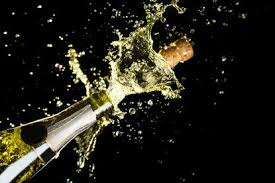
Any article that talks about Champagne, has to start out with the origin of Champagne and how it was made.
The history of Champagne has seen the wine evolve from being a pale, pinkish still wine to the sparkling wine now associated with the region.
The Romans were the first to plant vineyards in this area of northeast France, with the region being cultivated by at least the 5th century, possibly earlier. When Hugh Capet was crowned King of France in 987 at the cathedral of Reims, located in the heart of the region.
The cold winter temperatures prematurely halted fermentation in the cellars, leaving dormant yeast cells that would awaken in the warmth of spring and start fermenting again. One of the byproducts of fermentation is the release of carbon dioxide gas, which, if the wine is bottled, is trapped inside the wine, causing intense pressure. The pressure inside the weak, early French wine bottles often caused the bottles to explode, creating havoc in the cellars. If the bottle survived, the wine was found to contain bubbles, something that the early Champenois were horrified to see, considering it a fault. As late as the 17th century, Champenois wine makers, most notably the Benedictine monk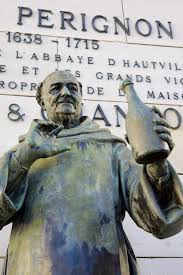 Dom Pérignon (1638–1715), were still trying to rid their wines of the bubbles. Many people believed that Dom Perignon was the founder of Champagne, he was not.. Instead he developed the first bottle that would contain the pressure without bursting the bottle.
The person really responsible for the birth of champagne, was Madam Clicquot. Advances by the house of Veuve Clicquot in the development of the méthode champenoise made production of sparkling wine on a large scale profitable, and this period saw the founding of many of today’s famous Champagne houses,
This describes the méthode champenoise used in making Champagne
Step 1: Selecting the Cuvée: The cuvée is the base wine selected to make the Champagne. The most expensive Champagnes are made from cuvées from Grand Cru vineyards in the Champagne region. Cuvées can be from a pure grape variety, such as Chardonnay or Pinot Noir, or can be a mixture of several grape varieties. Chardonnay is a white grape variety with white juice, Pinot Noir a red grape variety with WHITE juice. Pinot Meunier, a red grape, is a relative of Pinot Noir, also used extensively.
- Blanc de noirs means “white of blacks”. It is a white wine produced entirely from black grapes (another name for red grapes). Pinot Noir, Pinot Meunier are the only two black grapes permitted within the Champagne AOC.
- Blanc de blancs means “white of whites”, and is used to designate Champagnes made exclusively from Chardonnay grapes.
- Rosé wines (also known as Pink Champagne) are produced either by leaving the clear juice of black grapes to macerate on its skins for a brief time or, more commonly, by adding a small amount of still Pinot noir red wine to the sparkling wine cuvée.
Step 2: Assemblage is the French art of blending still white wines to create the base wine for Champagne. Assemblage is at the core of all fine Champagne.
Step 3: Tirage (the second fermentation): Next sugar, yeast and yeast nutrients are added, and the entire concoction, called the “tirage”, is put in a thick walled glass bottle and sealed with a bottle cap. The tirage is placed in a cool cellar (55-60 F) and allowed to slowly ferment, producing alcohol and carbon dioxide.
Step 4 Aging: As the fermentation proceeds, yeast cells die and after several months, the fermentation is complete. However, the Champagne continues to age in the cool cellar for several more years resulting in a toasty, yeasty characteristic. During this aging period, the yeast cells split open and spill into the solution imparting complex, yeasty flavors to the Champagne. The best and most expensive Champagne is aged for five or more years. This completes the second fermentation.
Step 5: Riddling: After the aging process is complete the dead yeast cells are removed through a process known as riddling (Le Remuage). The Champagne bottle is placed upside down in a holder at a 75 degree angle. Each day the riddler comes through the cellar and turns the bottle 1/8th of a turn while keeping it upside down. This procedure forces the dead yeast cells into the neck of the bottle where they are subsequently removed. A riddler typically handles 20,000 to 30,000 bottles per day.
Step 6: Disgorging: The Champagne bottle is kept upside down while the neck is frozen in an ice-salt bath. This procedure results in the formation of a plug of frozen wine containing the dead yeast cells. Finally, the bottle cap is removed and the pressure of the carbon dioxide gas in the bottle forces the plug of frozen wine out (“disgorging”) leaving behind clear Champagne.
Step 7: Adding the Dosage: At this point the “Dosage”, a mixture of white wine, brandy and sugar is added to adjust the sweetness level of the wine and to top up the bottle.
Step 8: Corking: The bottle is then corked and the cork wired down to secure the high internal pressure of the carbon dioxide. The sweetness levels of Champagne range from very dry (ultra brut) to very sweet (doux), with brut being the most common.
Reference: https://mobile.henrisreserve.com/
Why Champagne? Why Sparkling wine?
Champagne can only be called Champagne if it comes from the Champagne region in northern France. A typical Champagne or U.S. sparkling wine is made from a blend of three grapes: chardonnay, pinot noir, and pinot meunier. … Basically, that translate into no other wine producers of sparkling wines can call their product Champagne. Even though the process is identical, there is a lot of respect given to the origins of Champagne.
How to open a bottle of Champagne
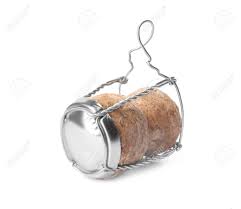 All champagne bottles from any country, always have
a wire cage that surrounds the expanded cork. To remove
this cork, you need to turn the cage exactly 5 and 1/2 turns.
That will completely open up the cage, so you can remove
the cork.
Sabering
This is another method, mostly for show to open a bottle of champagne. Its
called sabering 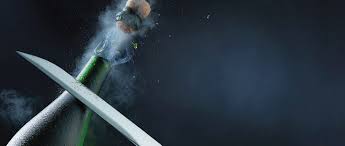 and you can use almost any device from a true saber to a simple kitchen knife. Word to the wise, this is not always the easiest way to open champagne and many times it results in a lot of champagne being wasted
Types of Sparkling Wines
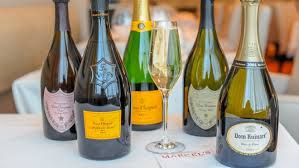
Champagne – Only for the Champagne Region of France
Cremant – Directly outside the region of France
Cava – Spain
Prosecco – Italy
Sekt – Germany
Sparkling – USA
Champagne or Sparkling Wine – Dry or Sweet
- Brut Nature: 0-2g/L. Brut Nature is also known as zero dosage, ultra brut, brut sauvage and non-dosage. …
- Extra Brut: up to 6g/L. Extra Brut has no detectable sweetness with 0-6g/L of residual sugar. …
- Brut: up to 12g/L. …
- Extra Sec: 12-17g/L. …
- Sec: 17-32g/L. …
- Demi-Sec: 32-50g/L. …
- Doux: more than 50g/L.
Call it Champagne or Sparkling wine, whatever, for years it has been the trademark of celebrations. For the crowning of a new ship, to a toast at a wedding, or to ring in the new year.
Whatever the occasion, its a special type of wine that everyone should try